Gear › The filters
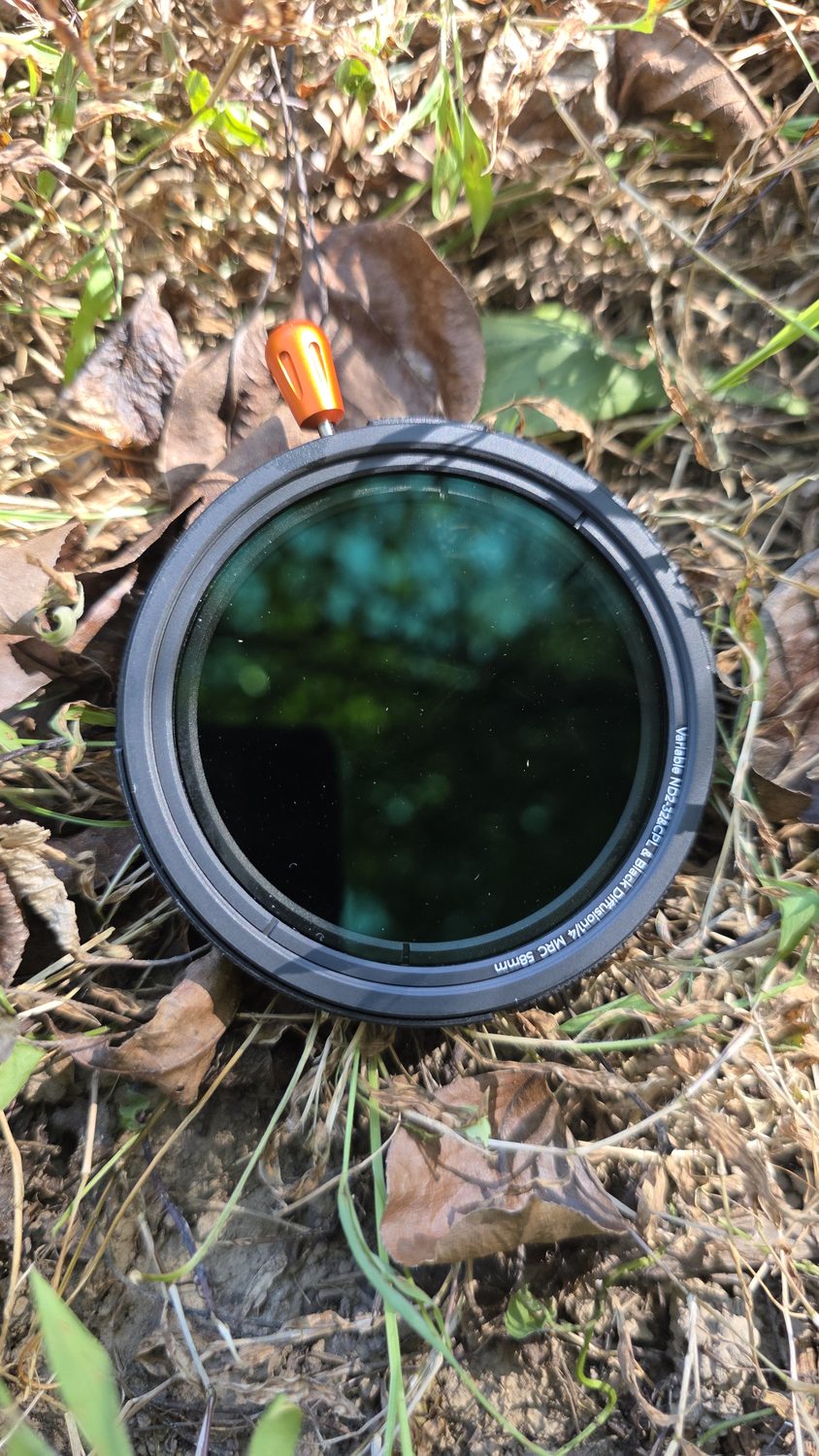
The filters
K&F Concept Nano-X 3-in-1: Variable ND2-32, CPL, and Black Diffusion Mist 1/4 (58 mm and 67 mm)
A circular polarizer is always on my camera. When the sun is out, I use the ND. That’s the one in the photo.
I have the set in two sizes: 58 mm for the everyday lens and 67 mm for the long one.
ND stands for neutral density. It cuts the light coming into the lens without changing its color. That’s the “neutral” part.
Photographers count light in stops. One stop is half the light. This one is variable: turn the front ring and it goes from ND2 (one stop, half the light) to ND32 (five stops, one thirty-second of the light).
Superpower 1: slow things down in daylight
On a bright day at f/8, the camera might want 1/250 of a second. Five stops of ND turns that into 1/8 of a second: 1/125, 1/60, 1/30, 1/15, 1/8. That’s slow enough for a waterfall to go silky and for moving water to smooth out, in the middle of the afternoon. A cable release helps here, so the camera doesn’t shake when you press the button. I prefer mine over the phone app 10 to 1.
Superpower 2: shoot wide open in the sun
There’s an old rule of thumb called Sunny 16: in full sun, f/16 at a shutter speed of about 1/ISO gets you a good exposure. Open up to f/2.8 for a blurry background and you’ve let in five more stops. At the camera’s base ISO that would take roughly 1/5000 of a second, faster than the mechanical shutter’s 1/4000. The electronic shutter can go faster, but it reads the sensor line by line and can bend anything that moves. The ND takes away those five stops, and the mechanical shutter is back in range.
Superpower 3: video that moves like film
Video looks most natural with the shutter at about twice the frame rate, so 1/60 of a second at 30 frames per second. It’s called the 180-degree rule, from film cameras with spinning shutters. In the sun, 1/60 lets in far too much light. The ND fixes that without closing the aperture down.
How a variable ND works
It’s two polarizing layers. Turn one against the other and less light gets through both, like two pairs of polarized sunglasses held at an angle. Push one too far and the frame can go dark in a big uneven X, so it’s best used inside its marked range.
Light bouncing off water, wet leaves, and glass comes off mostly vibrating in one direction. A circular polarizer (CPL) blocks that direction. Turn it and the glare on a river disappears so you can see the rocks underneath, and leaves go from shiny gray to green.
It also darkens blue sky. The effect is strongest at 90 degrees from the sun, so with a wide lens you can sometimes see a darker band across the sky. It costs about a stop and a half of light.
And if something is going to hit the front of the lens, I’d rather it be the filter.
A black diffusion mist filter softens the brightest parts of the frame and lets them glow a bit, and takes some of the digital edge off. The 1/4 is the strength, and it’s a light one.