Duncan's Landing
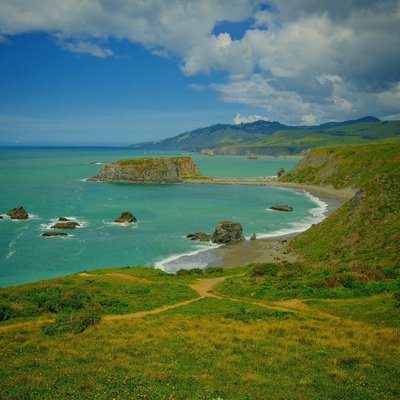
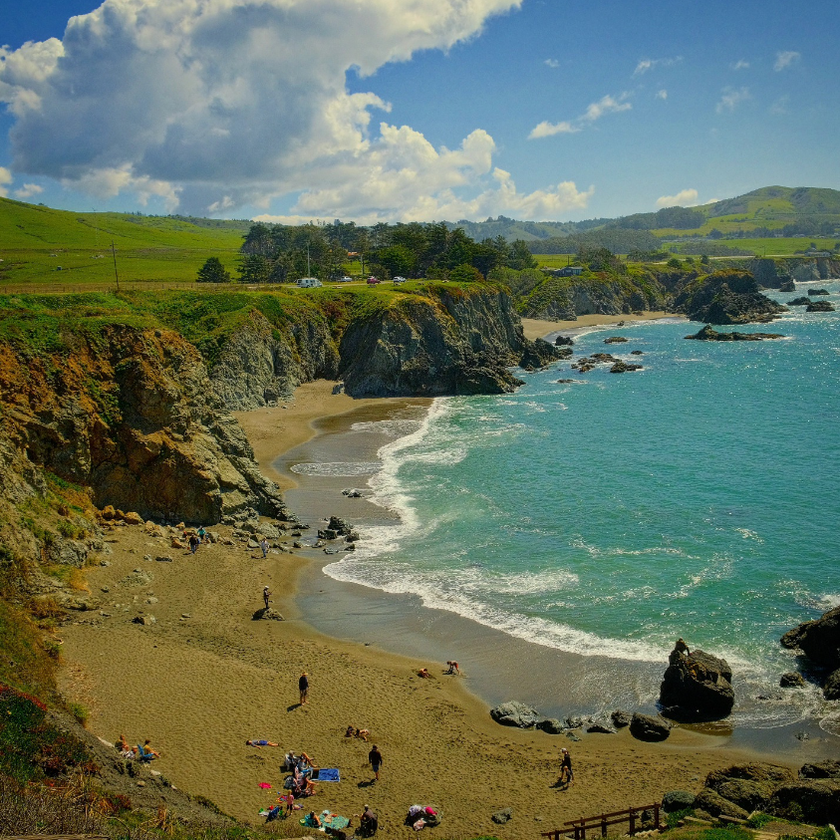
Duncan's Landing is a place where the coast gets serious fast. The frame holds coastal prairie, broken rock, and the blue-green churn of the Pacific below. Nothing about the scene feels ornamental. The bluff drops hard, the wind can push at you, and the water keeps working.
From this distance, the photograph becomes a study in edges: grass giving way to cliff, cliff giving way to surf, surf dragging the eye back into the open water. It is beautiful, but not soft. The Sonoma Coast has a way of making risk visible: steep ground, exposed edges, gusts off the water, and surf that does not announce every move ahead of time.
The smallness of the landform is part of the point. A person can stand above the cove and read the whole shape of it at once, but the ocean below is doing work on a different scale. The picture feels calm only because the camera is far enough away.
A clean line of coast, a hard drop, and enough wind to make the edge feel honest.
Sonoma Coast State ParkSonoma Coast State ParkA chain of beaches, coves, headlands, natural arches, tide pools, and camping areas stretching along the Pacific coast between Bodega Bay and the Russian River. is built out of repetition: beach, bluff, cove, rock, surf, then another turn of the road. Duncan's Landing sits inside that rhythm, but it has a sharper reputation. California State Parks describes it as an early landing for loading small coastal ships, and also as the most dangerous point along the Sonoma Coast because of large and unpredictable surf.
That history keeps the place from becoming a postcard. The landing was useful. The landing is beautiful. The landing is also not interested in being safe. State Parks tells visitors to heed the signs and stay off the rocks, noting that waves have reached the parking lot and people have been swept from the rocks.
The photograph works best when it keeps that tension. The grassy upper edge gives the frame a little quiet, while the heavy surfHeavy surfCalifornia State Parks warns that Sonoma Coast beaches can have strong rip currents, heavy surf, and sudden ground swells. below supplies the consequence. This is not a storm picture. It is a fair-weather place that still asks you to respect the edge.
The Sonoma Coast is not a single beach. It is a stitched-together coastline of secluded coves, rugged headlands, natural arches, fertile tide poolsTide poolA rocky intertidal pocket that holds seawater after the tide falls, creating habitat for small marine life., and long sections of rock bluff. In spring, the high ground around Duncan's Landing can carry wildflower color, while the lower edge stays cold, wet, windy, and exposed.