Hyatt Regency San Francisco
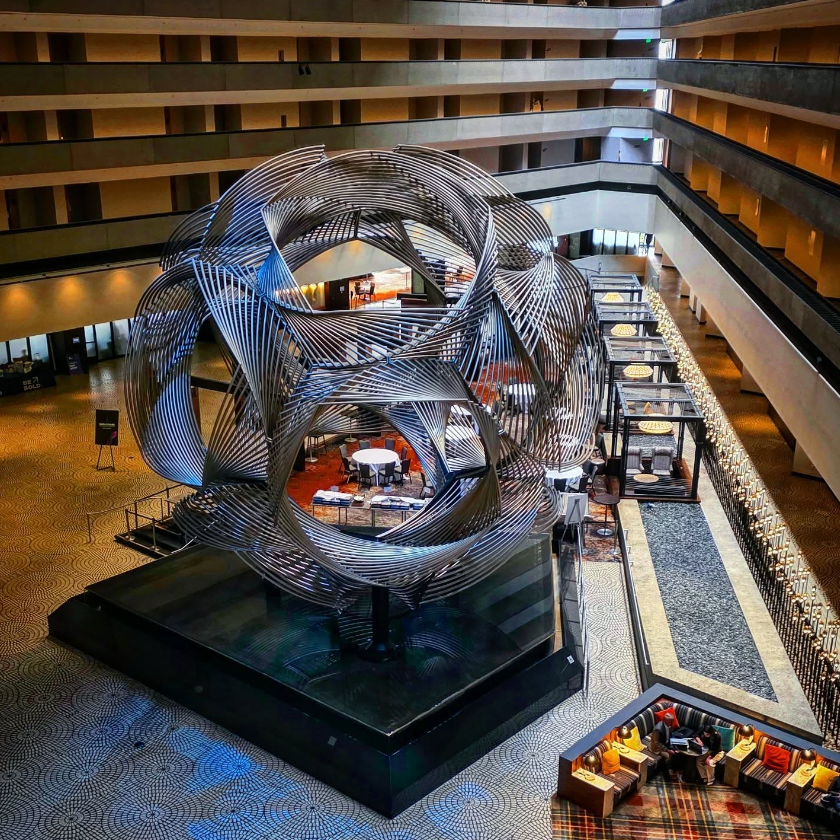
From above, the atrium stops behaving like a lobby. The floors stack into hard lines, the railings become rings, and Charles O. Perry's EclipseEclipseA large modernist sculpture by Charles O. Perry inside the Hyatt Regency San Francisco atrium. sits at the center like a mechanical sun.
The photograph works because the architecture is already doing most of the composing. John Portman'sJohn PortmanAn architect and developer known for dramatic atrium hotels that turn interior space into spectacle. hotel pulls your eye downward, then back outward, then down again. The sculpture answers with curves, voids, and reflections. Everything seems precise, but not quite calm.
That unease is why the room makes sense as a High AnxietyHigh AnxietyMel Brooks's 1977 Hitchcock parody used the Hyatt Regency San Francisco atrium as part of its San Francisco setting. location. Mel Brooks played the scene for comedy, but the space itself supplies the pressure: height, repetition, glass, exposed corridors, and the feeling that the floor is farther away than it should be.
The joke lands because the room already has nerves.
Perry's sculpture is the obvious subject, but it is not isolated from the building. It needs the atrium around it. The open void, the elevator towers, the balconies, and the lobby floor turn the sculpture into a point of orientation. Without that surrounding geometry, Eclipse would still be strong. Here, it becomes the room's compass.
The overhead angle matters. At eye level, the sculpture can read as an object. From above, it reads as a system: curves inside rectangles, metal inside concrete, light inside shadow. The frame lets the atrium become a diagram without losing the fact that people are moving through it below.
There is a reason film directors like places like this. The atrium is public, but it does not feel ordinary. It offers clean lines and vertigo at the same time. That tension gives the photograph its edge.