Tunnel View, Yosemite
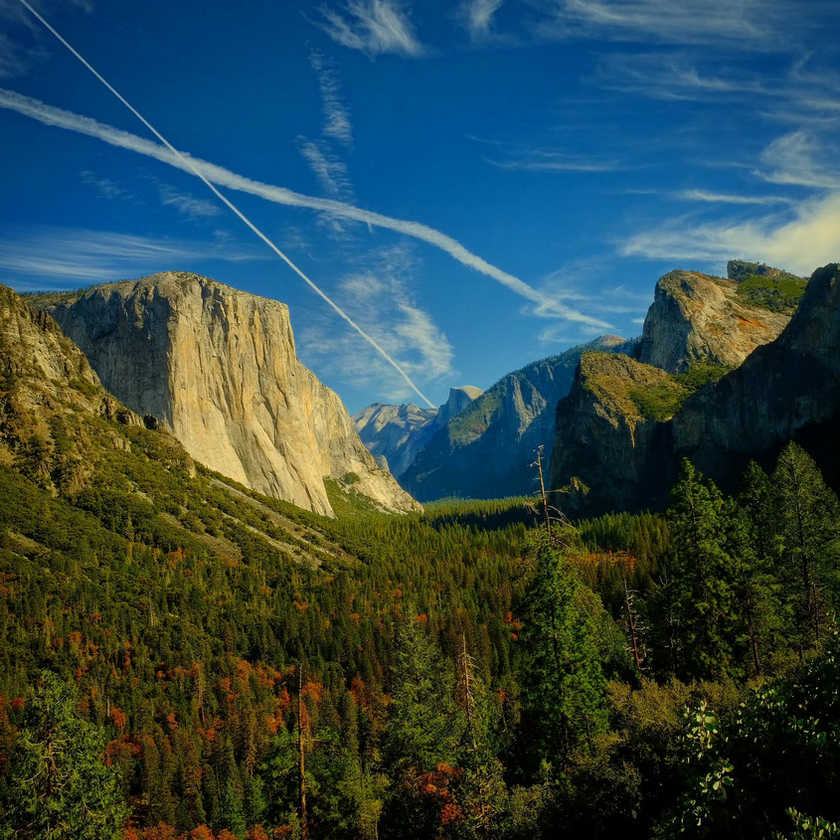
At Tunnel ViewTunnel ViewA famous Yosemite overlook near the Wawona Tunnel, looking east into Yosemite Valley toward El Capitan, Bridalveil Fall, and Half Dome., the valley does not reveal itself gradually. It opens all at once. The photograph has that same front-door feeling: stone walls, waterfall, sky, and distance arriving in one hard, clean composition.
The obvious landmarks are there: El CapitanEl CapitanA nearly 3,000-foot granite wall on the north side of Yosemite Valley, shaped by uplift, erosion, and glacial work on Yosemite's granitic bedrock. on the left, Bridalveil FallBridalveil FallA hanging waterfall on the south side of Yosemite Valley, where a tributary stream drops from a higher valley into the glacially carved main valley. to the right, and Half DomeHalf DomeA major granitic landform at the east end of Yosemite Valley, one of the park's defining shapes and part of the same geologic story of granite, uplift, and erosion. in the distance. The contrails overhead are small, but they matter. They put the present tense back into a view that can otherwise feel outside time.
What I like here is the scale discipline. Nothing in the frame needs help. The valley already knows how to be monumental. The photograph just holds the view steady long enough for the eye to move from the dark forested floor to the bright granite shoulders and then into the blue.
A whole valley arriving at once, with the sky keeping score above it.
Yosemite's drama is not just height. It is exposure. The granite was formed deep in the earth, lifted, worn down, and then carved by ice into cliffs, domes, and hanging valleys. Tunnel View compresses that long process into something immediately readable.
That is why the view can feel over-familiar and still work. It has been photographed endlessly, but the structure holds. The valley pulls the eye inward, the waterfall marks the right edge, and Half Dome waits at the back like a punctuation mark.