Palm Springs Air Museum
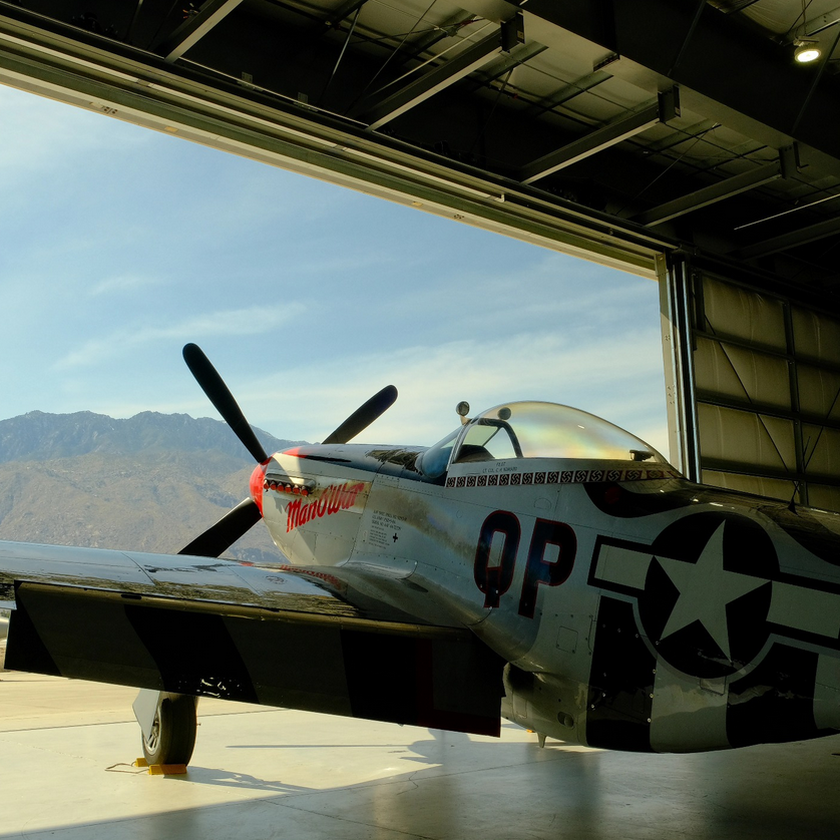
The airplane is the obvious subject, but the place does a lot of the work. The Palm Springs Air MuseumPalm Springs Air MuseumAn aviation museum in Palm Springs, California, known for preserved military aircraft, hangars, flight demonstrations, and desert airport setting. sits right against the light and space of the Coachella Valley. The open hangar keeps the aircraft in shadow while the mountains outside stay bright, which gives the frame its tension.
The P-51D MustangP-51D MustangA long-range World War II fighter built by North American Aviation, widely remembered for escort duty and for the D-model bubble canopy and Merlin-powered performance. has a way of looking fast even when it is parked. The nose stays long, the canopy sits low, and the wings look thin enough to belong to speed more than mass. In polished metal, it almost turns the hangar into a reflector.
What made this beautiful was not nostalgia alone. It was the contrast: a machine made for altitude and violence, resting quietly in a warm, bright place. The photograph lets the aircraft keep its history, but it also lets the desert soften the edges.
A fighter at rest, holding a little mountain light in its skin.
The Mustang's story is usually told through speed, range, and escort duty. That history matters, but the photograph is quieter than that. It is not a diagram or a victory poster. It is an aircraft in a place, and that place is doing its own kind of interpretation.
The Coachella ValleyCoachella ValleyThe Southern California desert valley that includes Palm Springs and the communities below the San Jacinto and Santa Rosa mountain ranges. has a clean, hard light that can make metal feel almost architectural. Against that backdrop, the aircraft reads less like a relic and more like a designed object: skin, rivets, canopy, intake, wing, shadow.
That is the balance worth keeping. The P-51 was built for a specific wartime job, but the photograph is not trying to make war beautiful. It is paying attention to form, preservation, and the strange grace of seeing a once-fast machine held still in a place that was beautiful to stand in.