My Garden
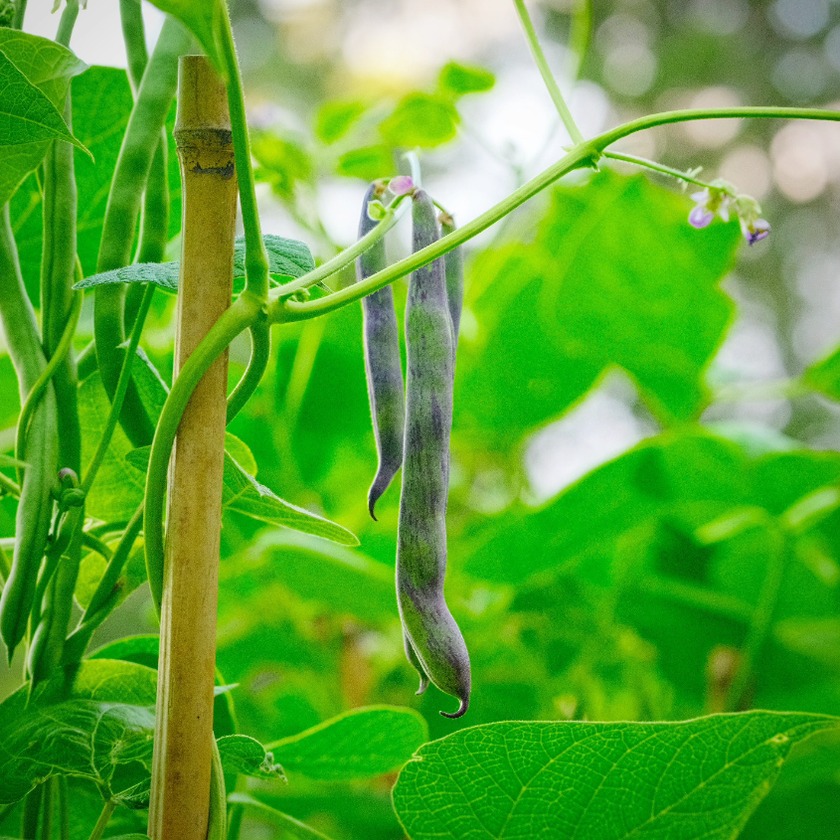
The bean vine gives the photograph its structure. A bamboo stakeBamboo supportA simple vertical support gives pole beans something to find, wrap, and climb, turning a small garden footprint into height. rises through the frame, and the pods answer it with their own lines: thin, curved, green, and streaked with purple. Nothing is staged like a still life, but the garden has arranged itself anyway.
Rattlesnake pole beansRattlesnake pole beanAn heirloom climbing bean known for green pods streaked with purple, useful fresh as a snap bean or mature as a shelling bean. are good subjects because they do not hide what they are doing. They climb. They twist. They make visible decisions around whatever support is close enough to touch. In a small garden, that upward habit matters. The plant turns a little square of ground into height.
What I like here is the plain usefulness of the scene. This is not a flower grown only for show. It is food, shade, seed, habit, and pattern, all working on the same bamboo pole.
A garden can be practical and still draw a beautiful line.
Rattlesnake beansCommon beanRattlesnake beans are a variety of Phaseolus vulgaris, the same common bean species that includes many snap, shell, and dry beans. are an heirloom pole bean in the common bean species, Phaseolus vulgaris. The variety is known for green pods marked with purple streaks, and those markings are the first thing the camera catches. They give the plant a little flash without making it ornamental only.
Pole beans also change the geometry of a garden. Instead of spreading low and wide, they pull upward by touch, wrapping around a trellis, cane, fence, or stake. That makes the plant useful in tight space and visually legible in a photograph. You can see the strategy.
Like other legumes, common beans have relationships with nitrogen-fixing bacteriaNitrogen fixationLegumes can partner with bacteria in root nodules that convert atmospheric nitrogen into forms plants can use.. That does not make a single vine a miracle worker, but it does place the plant inside the old logic of garden rotation: grow, eat, save, compost, plant again.